Posted on

Norbornene Click Chemistry

NBE-Click-Chemistry-Reagents

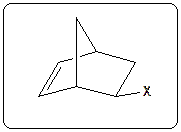
Norbornene (NBE) click reagents are designed for copper-free bioorthogonal conjugation with tetrazines through the inverse electron-demand Diels-Alder (IEDDA) reaction. With the chemical formula C7H10, norbornene consists of a strained alkene that is highly reactive with tetrazines, thiols, and other strong oxidizing agents. This provides a reactive handle that can be incoporated into various biomolecules for subsequent labeling and tagging. Physically, norbornene is a white organic compound with a strong unpleasant smell.

Key features:

  • Fast and selective: norbornene groups undergo fast and selective “click” reactions with tetrazines through IEDDA cycloaddition
  • Copper free: no Cu(I) catalyst required
  • Bioorthogonal: compatible with living biological systems and organisms
  • Versatile functionalization: available with different linkers

In an application of norbornene click chemistry, Woolley et al. (2025) developed lanthanide-tetrazine complexes that combined imaging capabilities in gadolinium, europium, and terbium probes and tetrazine-functionalized ligands that could provide MRI contrast. This was successfully conjugated with a norbornene-functionalized peptide that could create a bioorthogonal complex for targeting living tissue. Specifically, the blood brain barrier represents an attractive target for such modalities.

In another paper by Alves et al. (2022), researchers demonstrated the use of thiolโ€“norbornene photoclick chemistry to functionalize chitosan with antimicrobial peptides, highlighting norborneneโ€™s ability to create functional biomaterials. The resulting materials showed enhanced antibacterial activity against both Gram-positive and Gram-negative bacteria while maintaining good biocompatibility with human fibroblasts. The work highlights norbornene photoclick chemistry as a versatile, efficient approach for site-specific biomolecule conjugation and the development of functional antimicrobial materials.

Our norbornene reagents are available in a variety of functionalized formats, providing researchers with convenient building blocks for protein labeling, biomolecule conjugation, lipid modification, hydrogel formation, and molecular imaging.

References:

Alves, P. M., Pereira, R. F., Costa, B., Tassi, N., Teixeira, C., Leiro, V., … & Martins, M. C. L. (2022). Thiolโ€“norbornene photoclick chemistry for grafting antimicrobial peptides onto chitosan to create antibacterial biomaterials.ย ACS Applied Polymer Materials,ย 4(7), 5012-5026.

Woolley, B., Wu, Y., Xiong, L., Chau, H. F., Zhang, J., Law, G. L., … & Long, N. J. (2025). Lanthanideโ€“tetrazine probes for bio-imaging and click chemistry.ย Chemical science,ย 16(8), 3588-3597.

See Click Bioprobe’s list of norbornene reagents:

Posted on

FITC (fluorescein isothiocyanate)

Background:

Fluorescein belongs to a class of fluorescent chemical compounds known as small-molecule fluorophores. A synthetic compound, fluorescein emits a bright yellow-green fluorescence under blue light. With fluorescence microscopy and flow cytometry, fluorophores are often used to tag and visualize cellular structures in living organisms.

Fluorescein was first synthesized by German chemist Adolf van Baeyer, fusing phthalic anhydride and resorcinol in the presence of an acid catalyst. Since then, fluorescein and rhodamine, both xanthene dyes, have become some of the most widely-used fluorophores in research.

Fig. 1. Xanthene derivatives (Lavis, 2017).

Fluorescein has an emission maximum of 510 nm and fluorescence quantum yield of 0.86.

FITC Applications:

FITC is one of its many derivatives, in addition to fluorescein succinimidyl ester, that can be covalently attached to various molecules. Its large fluorescence quantum yield (brightness) and high photostability (resistance to chemical degradation when exposed to light) makes it a very common dye used in research applications.

The isothiocyanate group (-N=C=S) readily reacts with primary amines (-NH2), sulfhydryls (-SH), and nucleophiles that can be conjugated to amino acids and proteins.

Medical uses include topical application to the eye to highlight corneal damage and fluorescein angiography, an intravenous injection allowing doctors to map blood flow and vascular abnormalities.

Fluorescein is susceptible to photobleaching, or fading, under bright light, and can be heavily influenced by pH.

References:

Lavis, L. D. (2017). Teaching old dyes new tricks: biological probes built from fluoresceins and rhodamines. Annual review of biochemistry86(1), 825-843.

Sjรถback, R., Nygren, J., & Kubista, M. (1995). Absorption and fluorescence properties of fluorescein. Spectrochimica Acta Part A: Molecular and Biomolecular Spectroscopy51(6), L7-L21.

https://www.opsweb.org/page/FA

Explore Click Bioprobe’s fluorescent products:

Latest Blog Posts

Stay informed and inspired with our latest blog posts. Discover insights, tips, and trends across various topics.

Posted on

Carbonylacrylic Reagents

Background:

Carbonylacrylic (CBA) is a class of highly reactive reagents that undergo the Michael addition, primarily used for bioconjugation.

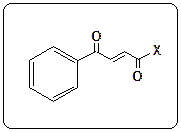
Molecularly, carbonylacrylic is an electron-deficient alkene that contains a double-bonded carbon backbone between two carbonyl groups. The alkene core (-CH=CH-) provides a rigid trans configuration that keeps the molecule extended and accessible. On one side, the carbonyl (-C=O-R-) is connected to a modifying R group, often phenyl ring, methyl group, or modifying ligand, and on the other side, the carbonyl attaches to an ester or amide. The two carbonyls are both strong electron-withdrawing groups, drawing electrons away from the central alkene double bond. This creates a highly electrophilic carbons in the center, suitable for reactions with electron-rich thiol groups (-SH) of cysteine residues.

In a Michael addition reaction, a carbonylacrylic moiety reacts with a cysteine to form a permanent bond. These are highly-specific, irreversible reactions that work in water and at room temperature. CBA reagents are superior to traditional maleimide reagents due to its stability in vivo. The reversible thiosuccinimide bond formed by maleimide is unstable in the bloodstream, gradually breaking down over time and releasing payload, potentially causing off-target toxicity. Furthermore, at basic pH levels, maleimide can cross-react with amine groups on lysine residues.

Overall, carbonylacrylic reagents are specialized crosslinking tools for bioconjugation.

Explore our reagents:

References:

Bernardim, B., Cal, P. M., Matos, M. J., Oliveira, B. L., Martรญnez-Sรกez, N., Albuquerque, I. S., … & Bernardes, G. J. (2016). Stoichiometric and irreversible cysteine-selective protein modification using carbonylacrylic reagents. Nature Communications7(1), 13128.

Bernardim, B., Matos, M. J., Ferhati, X., Companon, I., Guerreiro, A., Akkapeddi, P., … & Bernardes, G. J. (2019). Efficient and irreversible antibodyโ€“cysteine bioconjugation using carbonylacrylic reagents. Nature Protocols14(1), 86-99.

Posted on

DBCO Labeling

DBCO Click Chemistry Carbonyl Reactive

Background

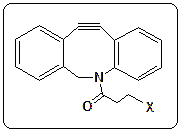
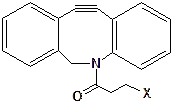
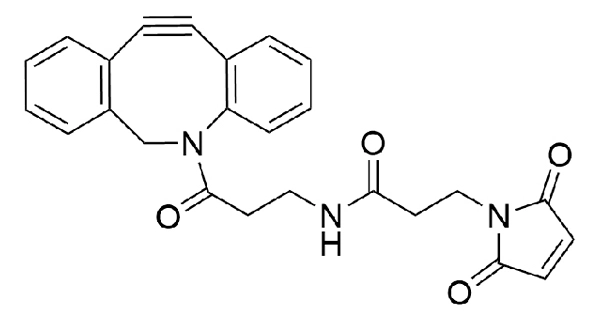
DBCO (dibenzocyclooctyne) labeling allows for a highly-specific, non-toxic copper-free method to covalently link biomolecules to azide-tagged targets. A bioorthogonal reaction, it does not interfere with natural biological processes in the cell. Common applications of DBCO labeling include antibody-drug conjugates (ADCs) for attaching payloads or fluorophores to antibodies, metabolic labeling for imaging, and affinity purification through DBCO-functionalized beads. Common reagents include amine-reactive DBCO, biotin-DBCO, and fluorophore-DBCO. DBCO polymer conjugation also allows for the linkage of functional polymers (PEG, dextran, chitosan) with azide-terminated biomolecules, nanoparticles, and surfaces.

Research

โ€œLabel-capture-releaseโ€ for isolating viable circulating tumor cells for drug testing

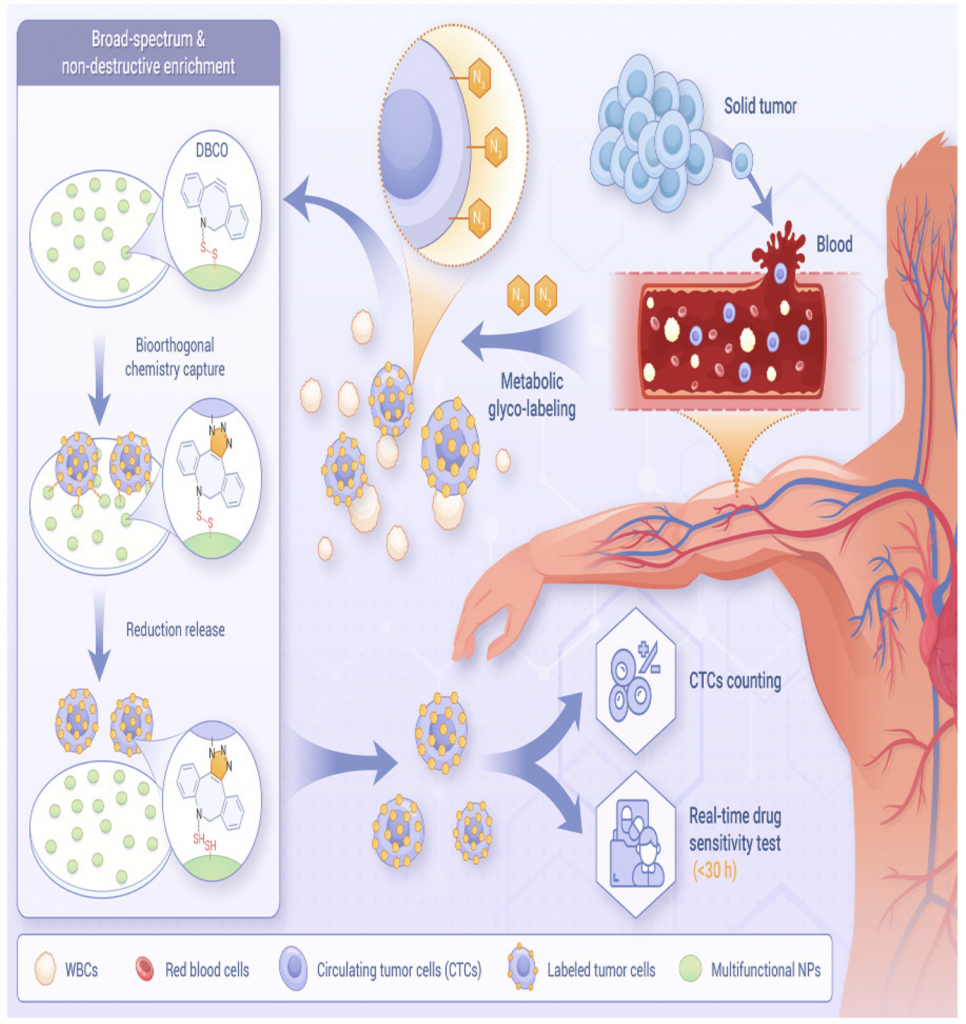
Chitosan has recently featured in several research publications, including Lao et al., 2025. In this study, researchers used DBCO-functionalized chitosan as a bioorthogonal capture surface for isolating circulating tumor cells (CTCs). They first labeled azide groups with an azido sugar precursor, which, after contact with the DBCO-coated chitosan surface, rapidly formed covalent bonds through copper-free strain-promoted azide-alkyne cycloaddition (SPAAC). This selective click reaction enables efficient capture of viable CTCs while minimizing nonspecific binding of normal blood cells. This method has shown promise across 10 different forms of cancer.

Fig. 1. Graphical abstract adapted from Lao et al., 2025.

Chitosan engineered for enhanced Mesenchymal Stem Cells Delivery

Zhao et al., 2026 used DBCO-functionalized chitosan to covalently anchor mesenchymal stem cells (MSCs) onto a chitosan scaffold. The stable cellโ€“scaffold linkage enhances secretion of neurotrophic factors, modulates the local immune environment, and promotes angiogenesis and nerve regeneration. In animal models of sciatic nerve injury, this bioorthogonal strategy significantly improved functional nerve repair compared with conventional MSC delivery. The clinical goal of this technology is to improve the effectiveness of stem cell therapy for repairing damaged peripheral nerves.

Conclusion

DBCO provides a wide range of ways to conjugate biomolecules for targeted fluorescence, delivery, and bioorthogonal applications. Learn more about CBP’s click chemistry reagents.

References:

Lao, Z., Ren, X., Zhuang, D., Xie, L., Zhang, Y., Li, W., … & Wang, H. (2025). A phenotype-independent โ€œlabel-capture-releaseโ€ process for isolating viable circulating tumor cells in real-time drug susceptibility testing. The Innovation6(5).

Zhao, X., Jiang, X., Liang, B., Deng, H., Ma, Y., Liu, X., … & Yang, Y. (2026). A Bioโ€Orthogonal Engineered Chitosan Platform for Enhanced Mesenchymal Stem Cells Delivery and Function in Peripheral Nerve Repair. Advanced Materials, e23237.

See CBP’s list of DBCO reagents:

Blog

This section provides an overview of the blog, showcasing a variety of articles, insights, and resources to inform and inspire readers.