
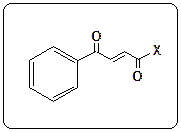
Background:
Carbonylacrylic (CBA) is a class of highly reactive reagents that undergo the Michael addition, primarily used for bioconjugation.
Molecularly, carbonylacrylic is an electron-deficient alkene that contains a double-bonded carbon backbone between two carbonyl groups. The alkene core (-CH=CH-) provides a rigid trans configuration that keeps the molecule extended and accessible. On one side, the carbonyl (-C=O-R-) is connected to a modifying R group, often phenyl ring, methyl group, or modifying ligand, and on the other side, the carbonyl attaches to an ester or amide. The two carbonyls are both strong electron-withdrawing groups, drawing electrons away from the central alkene double bond. This creates a highly electrophilic carbons in the center, suitable for reactions with electron-rich thiol groups (-SH) of cysteine residues.
In a Michael addition reaction, a carbonylacrylic moiety reacts with a cysteine to form a permanent bond. These are highly-specific, irreversible reactions that work in water and at room temperature. CBA reagents are superior to traditional maleimide reagents due to its stability in vivo. The reversible thiosuccinimide bond formed by maleimide is unstable in the bloodstream, gradually breaking down over time and releasing payload, potentially causing off-target toxicity. Furthermore, at basic pH levels, maleimide can cross-react with amine groups on lysine residues.
Overall, carbonylacrylic reagents are specialized crosslinking tools for bioconjugation.
Explore our reagents:
| Cat# | Name | Price | Stock status | Buy |
|---|---|---|---|---|
| CB-0018 | CBA (Carbonylacrylic) Cy3 | $284.00 | In stock | Add to cart This product has multiple variants. The options may be chosen on the product page $284.00 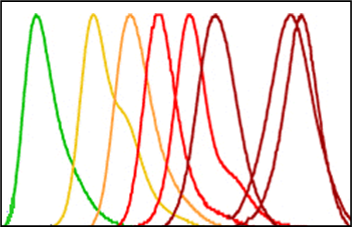 |
| CB-0019 | Carbonylacrylic Cy5 | $284.00 | In stock | Add to cart This product has multiple variants. The options may be chosen on the product page $284.00 |
| CB-0020 | Carbonylacrylic Cy5.5 | $284.00 | In stock | Add to cart This product has multiple variants. The options may be chosen on the product page $284.00 |
| CB-0021 | Carbonylacrylic Alexa Fluor 680 | $284.00 | In stock | Add to cart This product has multiple variants. The options may be chosen on the product page $284.00 |
| CB-0022 | CBA-Alexa Fluor 647 | $284.00 | In stock | Add to cart This product has multiple variants. The options may be chosen on the product page $284.00 |
| CB-0023 | Carbonylacrylic Alexa Fluor 488 | $284.00 | In stock | Add to cart This product has multiple variants. The options may be chosen on the product page $284.00 |
| CB-0024 | Carbonylacrylic DSPE | $284.00 | In stock | Add to cart This product has multiple variants. The options may be chosen on the product page $284.00  |
| CB-0025 | DMPE Carbonylacrylic Conjugate | $284.00 | In stock | Add to cart This product has multiple variants. The options may be chosen on the product page $284.00 |
| CB-0016 | CBA Carbonylacrylic FITC | $284.00 | In stock | Add to cart This product has multiple variants. The options may be chosen on the product page $284.00 |
| CB-0017 | Carbonylacrylic(CBA) Rhodamine | $284.00 | In stock | Add to cart This product has multiple variants. The options may be chosen on the product page $284.00 |
| CB-0015 | Carbonylacrylic(CBA) Biotin | $284.00 | In stock | Add to cart This product has multiple variants. The options may be chosen on the product page $284.00 |
| CB-0001 | Carbonylacrylic-x-NHS | Price range: $115.00 through $985.00 | In stock | Add to cart This product has multiple variants. The options may be chosen on the product page $115.00 $285.00 $985.00 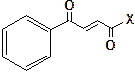 |
| CB-0011 | Carbonylacrylic amine | $284.00 | In stock | Add to cart This product has multiple variants. The options may be chosen on the product page $284.00 |
| CB-0012 | Carbonylacrylic-COOH | $284.00 | In stock | Add to cart This product has multiple variants. The options may be chosen on the product page $284.00 |
| CB-0013 | Carbonylacrylic(CBA) Carbonyl Hydrazide | $284.00 | In stock | Add to cart This product has multiple variants. The options may be chosen on the product page $284.00 |
References:
Bernardim, B., Cal, P. M., Matos, M. J., Oliveira, B. L., Martínez-Sáez, N., Albuquerque, I. S., … & Bernardes, G. J. (2016). Stoichiometric and irreversible cysteine-selective protein modification using carbonylacrylic reagents. Nature Communications, 7(1), 13128.
Bernardim, B., Matos, M. J., Ferhati, X., Companon, I., Guerreiro, A., Akkapeddi, P., … & Bernardes, G. J. (2019). Efficient and irreversible antibody–cysteine bioconjugation using carbonylacrylic reagents. Nature Protocols, 14(1), 86-99.