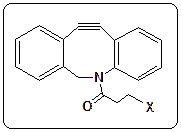
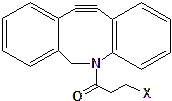
Description
DBCO-labeled Chitosan conjugate is one of CBP’s clickable polysaccharides that can react with azide groups. Chitosan is a natural polysaccharide derived from chitin, the fibrous structural polymer that forms the exoskeleton of shellfish. Chitosan is highly valued in drug delivery because it is biocompatible, biodegradable, non-toxic, and positively-charged, easily binding to negatively-charged membranes and genetic material, improving drug absorption. When used with nanoparticles, chitosan can protect fragile drugs for controlled release at target sites. Its attraction to negatively-charged red blood cells allows for erythrocyte aggregation, giving it powerful clotting properties and applications in bandages.
Labeling chitosan with a dibenzocyclooctyne (DBCO) group provides a highly reactive chemical linker to attach to other biomolecules. DBCO reacts easily with azide groups without needing a copper (I) catalyst, allowing researchers to combine chitosan’s therapeutic advantages with DBCO’s targeted fusion ability.
References:
Lao, Z., Ren, X., Zhuang, D., Xie, L., Zhang, Y., Li, W., … & Wang, H. (2025). A phenotype-independent “label-capture-release” process for isolating viable circulating tumor cells in real-time drug susceptibility testing. The Innovation, 6(5).
Zhao, X., Jiang, X., Liang, B., Deng, H., Ma, Y., Liu, X., … & Yang, Y. (2026). A Bio‐Orthogonal Engineered Chitosan Platform for Enhanced Mesenchymal Stem Cells Delivery and Function in Peripheral Nerve Repair. Advanced Materials, e23237.
Product Specifications:
- Form: Solid;
- Color: Off-white/light-yellow;
- Substrate: Chitosan, deacetylated polyglucosamine;
- Labeling ligand: DBCO;
- Labeling ratio: 8-12 DBCO per Chitosan;
- Solubility: Soluble in pH 3-5.
Storage Conditions:
- Store at 4 °C.
Data Sheets:
- Technical Data Sheet
- Safety Data Sheet
For more information or inquiries, reach out to info@clickbioprobe.com.